

(Photo credits: https://www.rottentomatoes.com/tv/the_white_lotus/s02)
The much awaited second installment of The White Lotus (TWL) has been hailed as one of the best series of 2022. Centered around guests of the eponymous luxury hotel in Italy, this season kicks off with a guest chancing upon a body floating near the hotel beach. Thus begins our endeavor of detecting the victim and killer.
TWL, however, is as much a murder mystery as Jordan Peele’s Get Out is a horror flick. Wrapped in a tapestry of breathtaking visuals and brilliant acting, the whodunnit is both a distraction from and hook into Mike White’s scathing critique of modern masculinity.
Two and a half men

A seemingly adorable grandfather, Bert DiGrasso is remarkably oblivious of his chauvinism. To him, women are the playthings of men. Flirting, he boasts, is one of the great pleasures of life. He makes a pass at every girl his geriatric eyes can see. He berates his son Dominic not for cheating on his wife, but for being sloppy at it.
In a particularly horrifying scene, Bert narrates with great glory the greek story of Hades raping Persephone. Bert goes on to note that, despite the rape, Hades was forgiven by Persephone’s father. All this to say that whatever Dominic has done cannot possibly be worse – implying that even rape is worthy of forgiveness. Of course, there’s no mention of what Persephone herself had to say.
Dominic stays mum, perhaps to avoid dignifying his father’s rhetoric. Perhaps not. A Hollywood hotshot and serial cheater, TWL’s Weinstein-lite may well have consorted with younger women. His dalliance with Lucia and Mia is just one indicator. Another is Dominic’s visibly painful resistance to his urge for young (possibly underage) girls at the hotel bar. Through Dominic, White perhaps tells us some men conveniently delude themselves into believing that their transgressions are attributable to a bonafide addiction – as if it’s a real disease.
The youngest DiGrasso is a tougher nut to crack. Albie is sensitive, considerate, a woke member of Gen Z. He understands that gender is a social construct. He schools his father and grandfather for thinking otherwise. However, despite Albie’s apparent enlightenment, he misses the wood for the trees. Albie’s attracted to “pretty, wounded birds” and makes it his mission to become their saviour. He conflates the need to respect women with becoming their knight in shining armor. This affects his ability to assess objectively. Since he has strong preconceived notions about sex workers, it simply does not occur to him that Lucia could be a sex worker by choice. He assumes – and doesn’t bother to verify – that Lucia is being exploited by a pimp. Lucia just feeds off this misconception and with great ease, pulls a fast one on him. If only Albie assessed Lucia as he would any other girl, he would have seen through her brittle facade.
In any case, Albie’s feminism is disingenuous at best. When Dominic is about to shed his old self, Albie makes him an offer he can’t refuse: transfer 50,000 euros to Lucia to pay off your karmic debt. This payment, Albie believes, will liberate Lucia from her oppressive and (fictitious) pimp. In turn, Albie will convince (read gaslight) his mother that Dominic has changed for good.
Albie essentially repackaged his father’s arduous journey of penance into a neatly securitized karmic instrument. In one fell swoop, Dominic pays off his karmic debt. Based on his reflexive turning head-turn at a young girl passing by at the airport, Dominic clearly treats his karmic payment as a license to commit fresh transgressions.
Bros before woes

Best described as a lovechild of Jordan Belfort and Andrew Tate, Cameron is Mike White’s unabashedly entitled, ignorant, and obnoxious man-child. His lack of respect for women so obvious that a deeper discussion is futile. That said, his dynamic with Ethan is emblematic of the prevalence, control, and effect of toxic masculinity in some male friendships.
For one, Cameron celebrates a man’s ability to cheat on his wife. Not cheating is a criminal waste of opportunity. Men, he says, have been brainwashed by the elite into becoming monogamous. To him, monogamy is nothing but a historical device used to keep the middle-class in check, while aristocrats would sleep with anything that moves. Cheating is thus a way to take back control from the ‘elite’. Whoever thinks otherwise (such as his friend Ethan) is not ‘man enough’.
Ethan, on the other hand, is well-informed, rational, and seemingly nice. He is shy and understated. Ethan is well aware of Cameron’s toxic behaviour, but remains his friend anyway. He struggles between his need for Cameron’s validation and urge to one-up Cameron’s alpha-dog aura with Ethan’s newly acquired wealth and status.
Despite this, Cameron manipulates Ethan to get his way. He uses Ethan’s room for sleeping with sex workers while Ethan himself just sits by, watching. Since he doesn’t want to be perceived as less manly, Ethan does practically nothing to dissuade Cameron. He then blatantly lies to Harper about the whole affair – just to honor the ‘bro-code’.
Ethan’s feminism (like Albie’s) is hollow at best. He truly believes that his refusal to sleep with another woman – even when he had the golden chance to do so – is worthy of his wife’s applause. This is only because to him, a man cheating on his wife is normal, a cliche even. He does not believe, therefore, that his restraint is an obvious expectation, the least a spouse would expect. Ethan is also absolutely fine with discussing his and Cameron’s college sex lives with the wives present. He gets extremely uncomfortable, however, when Harper narrates her sexual escapades from college.
Ironically, Cameron’s friendship towards Ethan is laced with some visible homoerotic undertones. Albeit playfully, he says at-least twice that he would “do”; to “be inside” him, do stuff to him, and make him feel good. This was perhaps White’s representation of repressed homoeroticism among frat-boys – the kind seen in hyper-masculine works like Top Gun and War.
The Male-trix

(Photo credits: https://www.vanityfair.com/hollywood/2022/11/the-white-lotus-season-2-easter-eggs)
Daphne, Cameron’s wife and mother of two, is a gut-wrenching reminder of how some men instill an illusory sense of control in their spouses. Despite Cameron’s poorly cloaked infidelity, she refuses to play victim. Daphne convinces herself that she is in full control of her marriage. Her way of fueling this sense of control is spending mounds of money, trying to out-fun Cameron, making him jealous – which in her mind is evidence of her freedom.
In reality, Daphne does only what Cameron’s behaviour makes her want to do. She has little control over her own life. Cameron is aware of this – apart from ‘punishing’ him with large spends, Daphne is unable to leave Cameron or affect him in any way.
Daphne too seems aware of this. She tries to build her own reality. Having learned of Cameron’s latest transgression, she tells Harper that she also cheats on Cameron with a blue-eyed trainer. The photo she pulls out, however, turns out to be her son’s. There is no trainer. It’s only her way of telling Harper that she spends most of her time with her blue-eyed boy while Cameron is gallivanting around; that Harper should expect the same and, pre-empt it, and get her own ‘trainer’ (read child) to absorb the shock.
Initially a possible protagonist, Harper turns out to be no angel. Daphne thinks Harper is different; that she can be trusted. Unbeknownst to her, Harper’s primary mission for the trip was exposing Daphne’s marital ruse. Right after Daphne confides in her, Harper spills the beans on Daphne’s fake marriage to Ethan. Daphne has no female friends, she says, because all they all talk shit behind her back. This, as Ethan notes, is exactly what Harper does to Daphne. This is perhaps White’s way of telling us that sometimes women, even intellectual feminists, perpetuate the stereotype that female friendships are brittle and toxic.
The Great Distraction
White’s ace in the hole is Tanya. On the surface, she is a wealthy, eccentric, and middle-aged woman. We think she has returned to the series for comic relief. But White’s real purpose for her is to distract us. He knows that our preconceived notions about gendered roles will distort our ability to watch the show objectively; that in the world of Real Housewives of Hollywood, we will undermine the credibility of Tanya’s accurate detections because of how people see all wealthy middle-aged women as frivolous, hedonistic, narcissists.

(Photo credits: https://www.vanityfair.com/hollywood/2022/11/the-white-lotus-season-2-easter-eggs)
We would find it perfectly normal if a man dreamt of smoking a cigar while racing a red Ferrari across Sicily. But White knows that Tanya’s Italian dream of smoking a cigarette, riding a Vespa, and eating pasta would only make her look frivolous and pathetic to us. Because we don’t take her seriously, we miss that the entire murder plot is incrementally revealed to us through Tanya. She dreams her murder by effeminate men; she is suspicious of Greg right from the start. Despite his meticulously gaslighting, Tanya confirms to us that she is within her senses. She knows what she is saying (she remembers the macaroons she had). In fact, in almost a fourth-wall breaking way, she proclaims “I am paying attention”. “I am paying attention, you don’t like me” she adds, as if to level another accusation against us. If our judgment were not clouded by our preconceived notions, we might have thought harder about these clues.

(Photo credits: https://deadline.com/wp-content/uploads/2022/10/the-white-lotus_13.jpg?w=681&h=383&crop=1)
Tanya does get one thing wrong. Like many viewers, she thinks all gay men are fashionable, flamboyant, and debauched. Most important, she thinks they are harmless to women. Her otherwise sharp assessment, is muddled by the gay stereotype. Quentin, and his cohort (‘the Gays’), exploits each of preconceived notions to lure her into his trap. By making her feel beautiful, Quentin feeds off Tanya’s poor self-image – one that Greg had so painstakingly worked to destroy. White also uses Greg to successfully flip the gold-digger stereotype.
Interestingly, Quentin and Jack – TWL’s two main conmen – boast British accents. This can’t be a coincidence. The British accent apparently makes its speakers more masculine, alluring, and trustworthy. Quentin’s accent, known as the received pronunciation (RP) or the Queen’s English, directly feeds into his claim to aristocracy. Jack, on the other hand, has a Cockney accent – making him more accessible to his target, Portia. In yet another way, Mike White exposes the extent to which our notions of masculinity can cloud rational thought.
L’Avventura
(Photo credits: https://nypost.com/wp-content/uploads/sites/2/2022/12/haley-lu-richardson-leo-woodall_2.jpg)
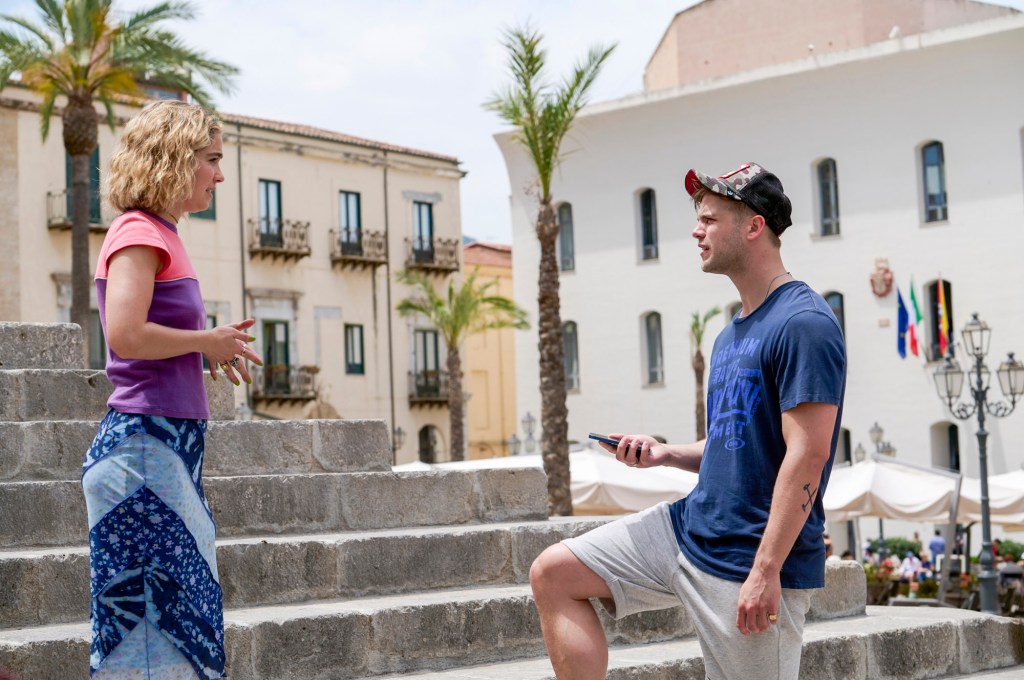
White knows that most viewers would share Albie’s notions about oppressed female sex workers. However, in TWL, it is in fact Jack who seems to be exploited into selling his body and soul to Quentin. But it simply does not occur to Portia that Jack, a man, could ever be in such a position. She checks Albie’s instagram within moments of meeting him, but does not check Jack’s until it’s too late. She thinks nothing of Jack’s failure to pay for a 1-dollar rice ball; and she pays no heed to Tanya’s warning. This is because Portia, as smart is she is otherwise, is not thinking rationally. She wants a dominating, aggressive man to yank her out of numbness, boredom and existential crisis. Had she not conflated male aggression with liveliness and adventure, Portia would have seen through Jack’s façade.
Eventually, Portia does find out. Though he was likely tasked with eliminating Portia, Jack lets her go – even at the risk of heavy repercussions from the powerful masters. He does so out of respect for Portia, particularly her intellect – not because he thinks of her as a damsel in distress. On the contrary, Lucia, who faces no oppression or life threats, pulls a neat one over Albie. This too is perhaps White’s way of dispelling our notion that a person’s character can be derived from their gender role.
Flipping more stereotypes

(Photo credits: https://www.thesun.co.uk/tv/17283227/the-white-lotus-season-2-cast/)
Lucia feels “like shit” for being a sex worker. “All whores are punished in the end”, she proclaims. But Mia dispels these irrational notions. She reminds Lucia that they have it well; that “having sex knowing exactly what you are going to get of it is not so bad”, reminding us that sexual certainty is a basic privilege several women do not enjoy.
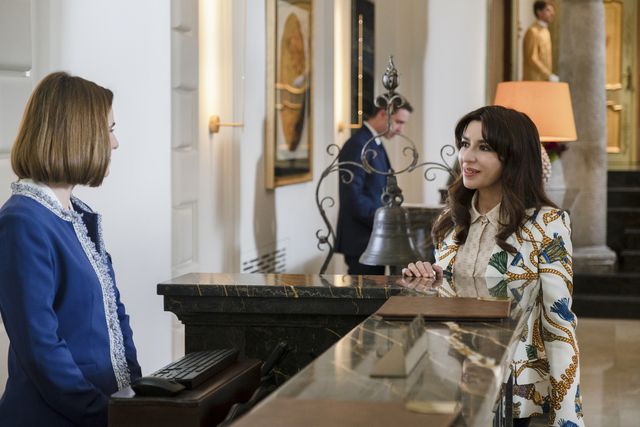
Then there’s Valentina, director of the hotel. She is direct, assertive, explosive. She likes women, but is yet to come out of the closet. Valentina does not respect sex workers. To her, Lucia and Mia are socially inferior and morally corrupt. She does not deem them worthy of access to a 5-star hotel. When Dominic gets Lucia and Mia registered as guests, Valentina is visibly disappointed. This is right before Lucia deftly reminds her that luxury hotels were created on the backs of girls like her.
Nonetheless, Valentina remains obstructive. Though Mia is clearly more talented, she would rather let the piano languish than let a sex worker sing at the hotel restaurant during Giuseppe’s absence. This is quite ironic given that many in India (at least historically) harbored the notion that commercial singing is an occupation for sex workers.
(Photo credits: https://www.digitalspy.com/tv/ustv/a42164719/the-white-lotus-sabrina-impacciatore-finale/)
Meanwhile, Valentina struggles with her own sexuality. Much like traditionally masculine men, Valentina takes her colleague Isabella’s kindness for romantic interest. She buys expensive jewelry in a bid to win Isabella’s affection. Tellingly, she checks with Isabella if Rocco, her colleague, is making her uncomfortable. “Men can be intrusive and aggressive”, she says.
In reality, it is Valentina who aggressively pursues her interest in Isabella. She abuses her professional power to separate Isabella from Rocco – who turns out to be her boyfriend and later fiancé. Much like Albie, Valentina takes on a misguided responsibility to rescue all women. She even replaces Rocco with Salvatore – the kind of flirtatious creep Valentina wanted Isabella to stay away from. Far from saving her, Valentina ends up becoming aggressive and intrusive to Isabella.
Ironically, it is Mia who helps Valentina step out of the closet; makes her feel accepted. In the process, Mia also reminds Valentina should help – and not judge – other women. This way, Mia helps Valentina look past her own bias. Once Valentina has reached there – she can see for herself that Mia is objectively more meritorious than the incumbent Giuseppe. So Mia bags the job not because of her sexual favour for Valentina, but because she truly deserves it.
Last words
TWL is rife with pejorative terms like shrew, whore, slut, banshee, and old battle-axe – all created and aimed primarily at women. Through TWL, White also forces the audience to introspect on the continued use of terms designed to denigrate women.
Almost all characters suffer one way or another because they make assessments based on preconceived notions attached to gender or masculinity. Through TWL, Mike White wants to make us wonder if we do the same.
 Ityādi Diaries

:format(webp):no_upscale()/cdn.vox-cdn.com/uploads/chorus_asset/file/24143730/whitelotus4.jpg)


Leave a comment