The Tragedie of Macbeth is dark and delicious. There’s something murky, visceral, and devastating about it. Every reading evokes a grey cloud. Yet, Shakespeare’s tight dialogue and raw emotion keep you going back for more. This is also true of film adaptations – especially the hauntingly good ones by Vishal Bhardwaj (2003, available on Prime Video) and Joel Coen (2021, available on Apple TV).
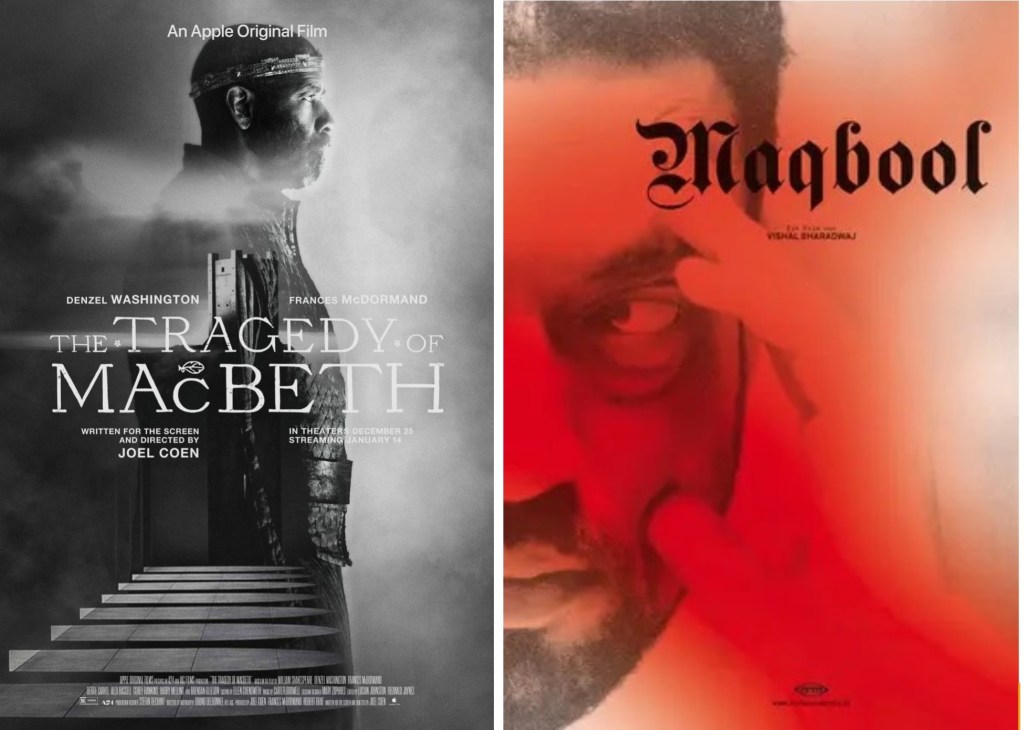
Like the earlier one on The Merchant of Venice, this piece does not try a review or critical analysis of the Bard’s shortest tragedy. Instead, it speculates that Macbeth’s fate was written by his own mind.
The Plot
Macbeth is a Scottish general under King Duncan. He is skilled, ruthless, and loyal. With his friend Banquo, Macbeth quells a traitor’s uprising. On their way back, they sight a trio of witches. The Weird Sisters greet Macbeth not only with his title, but also as the Thane of Cawdor and king that will be. Banquo, the witches say, will beget a line of kings. The Scots almost laugh it off— until, soon after, Macbeth is named Thane of Cawdor.
Lady Macbeth is determined to realise the witchy words. She spots the perfect opportunity when Duncan visits the Macbeth residence. In the night, Lady Macbeth ensures that Duncan’s guards are consumed by wine. While Macbeth has second thoughts, his Lady instills the courage to do what is necessary. And the deed is done.
Duncan’s guards are found smeared in royal blood. Before they can snap out of their drunken stupor, Macbeth slits their throats. Malcolm, Duncan’s son, absconds. Macbeth is crowned.
The crown does not sit easily on Macbeth’s head. He is haunted by Duncan. Recalling the prophecy, Macbeth resolves to kill Banquo and his son. While his friend falls, the latter escapes. Macbeth loses control. Unloved by his court and subjects alike, he is branded a tyrant.
Macbeth summons the Weird Sisters. They warn him of Macduff, the Thane of Fife. No harm will come to Macbeth, they say, from any born of woman; he won’t be vanquished until Birnam Wood comes at him. Macbeth is reassured, but only for a moment. He commands his troops to slaughter Macduff’s wife, children, and all sharing his blood. Unable to wash off her sins, Lady Macbeth first loses her mind; then her life.
Macduff stands at the gates of Dunsinane— with him, the groves of Birnam Wood. When Macbeth cites the prophecy, Macduff reveals he was untimely ripped from his mother’s womb. Macbeth falls.
A Battle Within
Macbeth is a man of honour. He lives and dies by the sword. Most of all, he is a man. To him, duty is paramount.
But the mind is a creature of its own. Freedom, the oxygen dearer than oxygen, has no trace in Macbeth’s mind. It has no space for reason; no paths on which to wander without purpose. In his world, a man like Macbeth can never put down his weapons; lower his guard; lick his wounds; or shed the burden of responsibility. A decorated general in attire, he is a slave of external expectations. Like a parched man can see sweet water in the desert, unbeknownst to him, Macbeth’s mind can taste freedom in the crown. Without an outlet, however, these thoughts are stored only in repression.
Macbeth is in two minds. One, vying for freedom- whose path leads to regicide. The other, preserving honor- whose only reward is glorified enslavement. The two minds battle fiercely. His head turns foggy. A filthy air fills his thoughts. The Id, Ego, and Super-ego hover through. The one mind- vessel of Macbeth’s desire and weakness- seeks audience. The two minds make a pact. Macbeth will hear the nefarious mind- but not as his own. A ‘real man’, Macbeth cannot be weak. Most of all, he cannot be seen weak. He begins to dissociate, and from the darkest crevice of his troubled mind, the Weird Sisters appear.
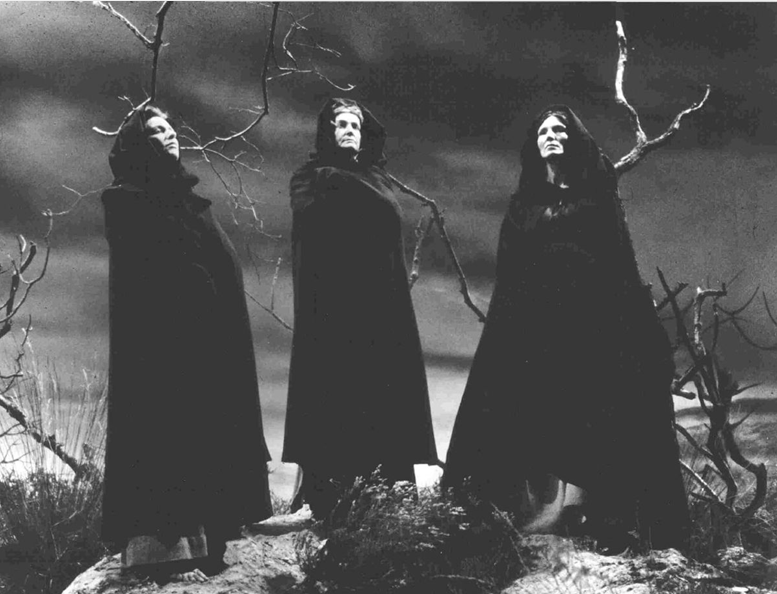
“Fair is foul and foul is fair / hover through the fog and filthy air”
Battered and exhausted by battle, Macbeth and Banquo stare at the Weird Sisters – dazed by a collective psychosis. The witches first speak out Macbeth’s nefarious mind; packaging desires into prophecies for Macbeth. To Banquo, they speak through Macbeth’s honourable mind- the part which knows his path will leave him without heir, kingdom, and friend. It wishes well for Banquo but cannot save him. It settles for Fleance and, through him, a line of Banquo kings. It is in this moment that the fate of all characters in the play is sealed— in Macbeth’s mind.
Madness, as they say, is like gravity. All it takes is a little push. Enter, Lady Macbeth.
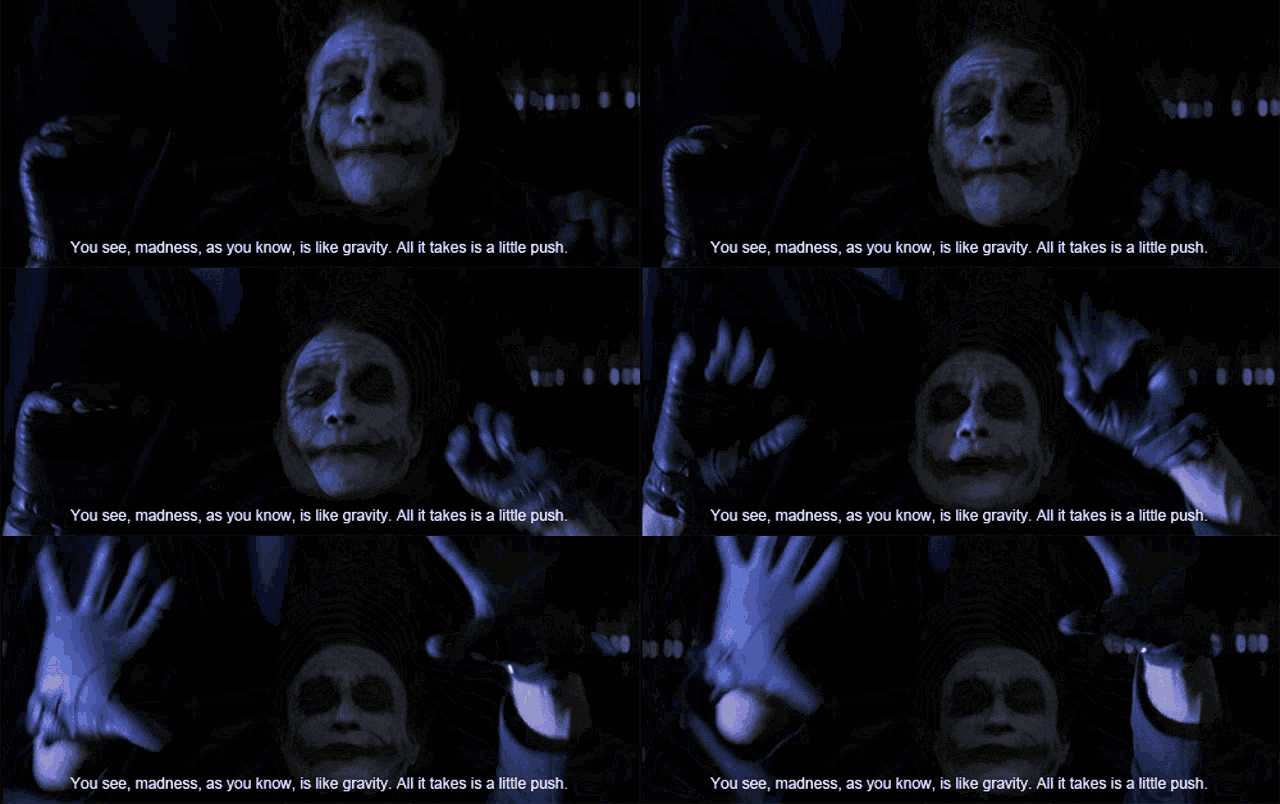
Christopher Nolan’s ‘The Dark Knight’ (2008)
The Lady is easier to hate than understand. She is neither a damsel in distress nor decorative appendage. She is determined, complex, and ruthless. She also has the stomach to carry her ambition.
“Lady Macbeth: The raven himself is hoarse
That croaks the fatal entrance of Duncan
Under my battlements. Come, you spirits
That tend on mortal thoughts, unsex me here,
And fill me from the crown to the toe top-full
Of direst cruelty. Make thick my blood.
Stop up th’ access and passage to remorse,
That no compunctious visitings of nature
Shake my fell purpose, nor keep peace between
Th’ effect and it. Come to my woman’s breasts
And take my milk for gall, you murd’ring ministers,
Wherever in your sightless substances
You wait on nature’s mischief. Come, thick night,
And pall thee in the dunnest smoke of hell,
That my keen knife see not the wound it makes,
Nor heaven peep through the blanket of the dark
To cry “Hold, hold!”
Lady Macbeth is fiercely protective of her husband. She is ‘masculine’ in the traditional sense – in many ways more so than Macbeth. She will do anything to realise the prophecies, even if Macbeth himself lacks the will. She fears Macbeth will succumb to his softer side— the one “…too full o’ th’ milk of human kindness”. Rightly so. Having resolved to murder the King, Macbeth’s honorable mind sends him into a guilt-ridden slump.
Macbeth is on the precipice. He must choose: duty and honor? Or prospect and power? The fog in his head grows thicker. His teeth clench: his temples expand with a throbbing bulge. A crippling paralysis slithers into his mind. He’s unable to clasp the weapons – until his eyes paint them red. Before he can make sense of it, Macbeth is pulling out a dagger from Duncan’s beating heart. Macbeth’s face is splattered with red. There is no turning back now. The deed is done. Macbeth’s minds enmesh into a terrible, unrecognisable sludge.
His soul descends into a bottomless pit.
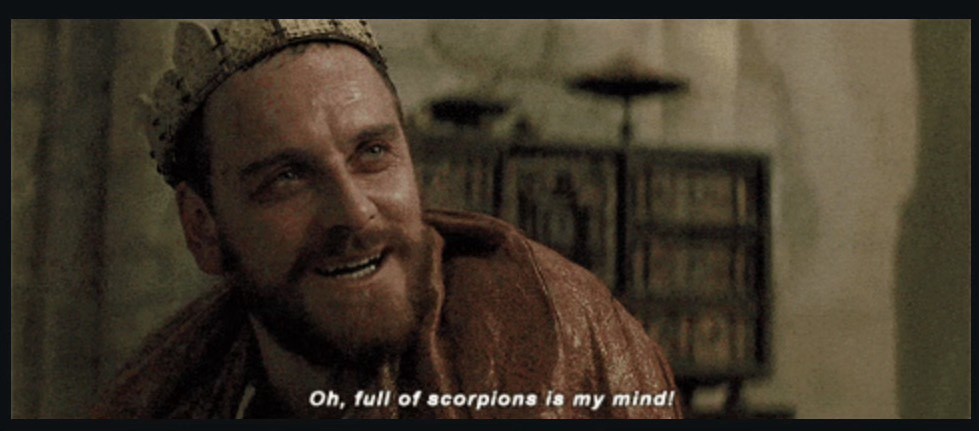
Justin Kurzel’s Macbeth (2015)
Reason and morality are exiled. Macbeth’s mind is a cocktail of insecurity, rage, and guilt. His primal response is combat. He has trained all his life for it – and he is the best. Now that restraint has no refuge in his mind, Macbeth is taken over by an impulsive bloodlust. He slaughters his dearest friend; wipes out Macduff’s entire family in one fell swoop – only to be haunted by them all. To protect his crown, he loses his head.
When he learns Macduff’s not born of woman (in the conventional sense), Macbeth regains full consciousness. He was betrayed this whole time – by none other than his own mind. He is sucked out of his own spiral. The prophecies, stories constructed inside his mind, vaporise. The two minds separate. Reason awakens. He winces at the horrors of his crimes. In that moment of clarity, Macbeth is tried and convicted by his conscience. For his final act as King of Scotland, he sentences himself to death; offering no resistance to Macduff’s blade.
Closing thoughts
Macbeth wanted to feel. He wanted to love and be loved, to be soft and relaxed, to howl at the death of his beloved wife, to lament his lack of child, to revel in his friendship with Banquo, to lead a simple life, grow old in peace. However, the demands of his rigid social roles created a chasm inside his mind- leading him to repression, disassociation, and delirium.
Perhaps every mind has two hearts. One aches to break free. The other tempers it with the demands of duty. A delicate balance must be struck. Choice is key – but no choice is true if the mind is unfree. The mind seeks care, freedom, and temperance. Starve it of any one of them, and the mind can unleash rebellion.
-Ritvik Kulkarni
 Ityādi Diaries
Leave a comment